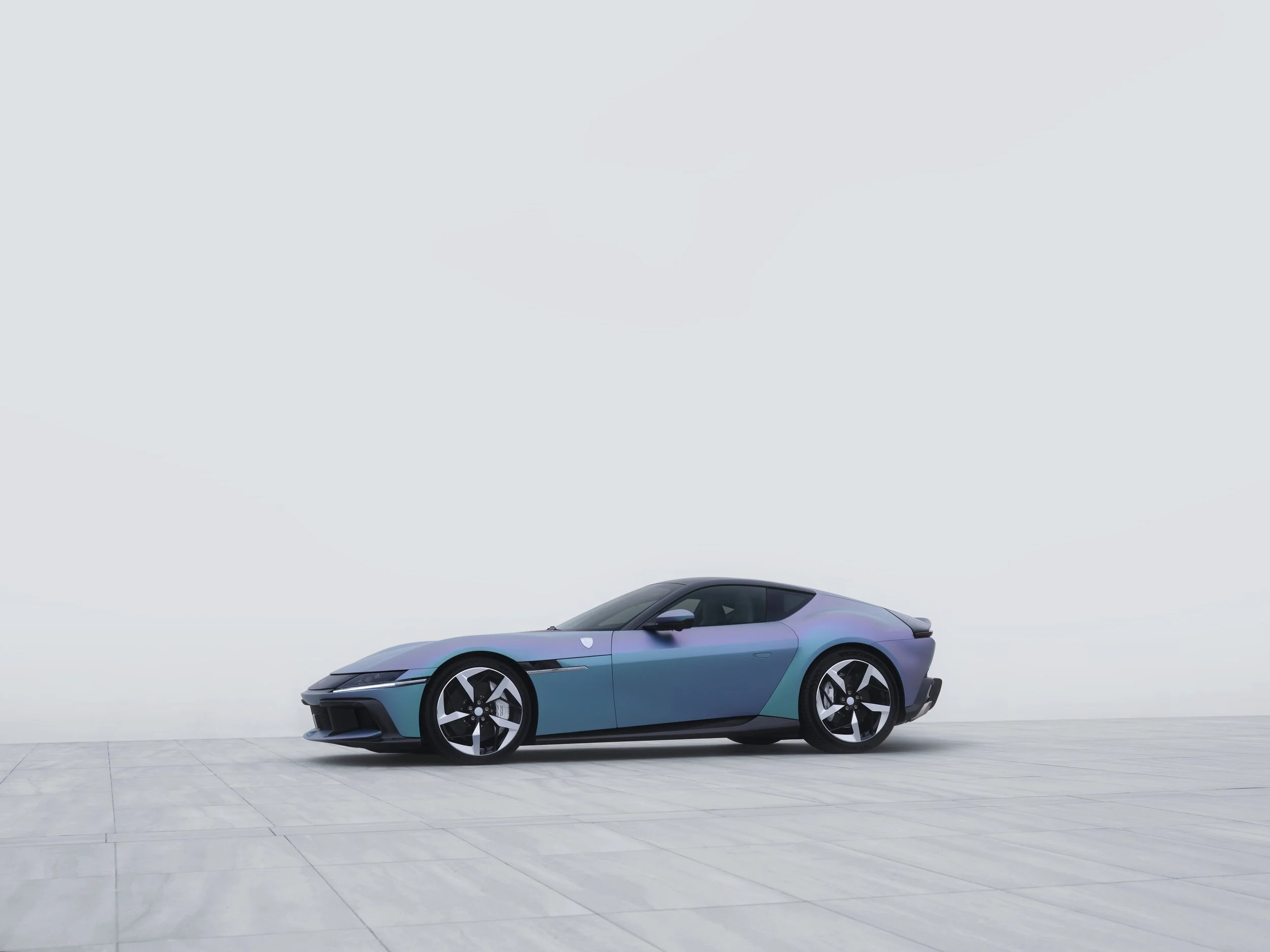
Ferrari 12Cilindri Tailor Made

전통에서 영감을,
혁신으로 나아가다
페라리는 쿨 헌팅(COOL HUNTING)과의 협업 아래, 동시대 한국 작가들과 함께 한국을 기리는 단 하나의 12칠린드리 테일러메이드를 완성했다
Inspired by Tradition,
Driven by Innovation
Ferrari and COOL HUNTING collaborate with contemporary Korean artists, creating a one-of-a-kind 12Cilindri Tailor Made honoring Korea
정다혜
Dahye Jeong


12칠린드리 대시보드 중심을 이루는 말총 직조의 기하학. 파노라마 루프와 맞춤형 텍스타일로 확장된 연대의 구조
정다혜는 말총이라는 단일하고도 특수한 재료를 통해, 수개월에 걸쳐 손으로 정성스럽게 완성되는 섬세한 조형 작품을 만든다. 그녀의 작업에서 시간은 보이지 않는 재료가 되며, 작가는 이 과정을 ‘시간에 대한 축적’으로 바라본다. 이는 작업을 통해 ‘성실의 시간’을 지속적으로 유지해 나가는 작가의 태도를 반영한다.
말총 직조 기법은 조선시대(1392-1910)로 거슬러 올라가며, 본래는 남성의 신분을 상징하는 모자를 제작하는 데 사용되었다. 원통형의 관과 넓은 챙을 지닌 ‘갓’을 비롯해, 머리카락을 고정하기 위한 띠 형태의 ‘망건’, 그리고 망건 위나 갓 아래에 착용되던 실내용 모자인 ‘탕건’은 모두 당시 사회적 위계를 드러내는 상징적 장신구였다. 이러한 말총 직조 기법을 바탕으로, 작가는 이를 바구니와 오브제 작업으로 풀어내며, 신석기 시대로 거슬러 올라가는 한국 공예의 또 다른 중요한 전통인 빗살무늬 토기의 장식적 기형을 자신의 작업 안에서 새롭게 재해석한다. 이를 통해 말총 직조는 특정 용도에 국한된 기술을 넘어, 구조와 장식이 공존하는 조형 언어로 확장된다.
이 작업의 출발점은 그녀의 고향 제주에서 열린 한국공예·디자인문화진흥원(KCDF) 프로그램이었다. 바늘로 말총을 한 올 한 올 엮어 기하학적 패턴을 만들고, 제주에서 그녀의 아버지가 제작한 나무 틀을 중심으로 형태를 구축하며 작업을 시작한다. 이후 열처리 과정을 거쳐 내부의 목재를 제거하면 유연하면서도 끊어지지 않는 구조의 조형물이 드러난다.
정다혜가 말총에서 발견한 핵심 가치는 ‘강인함’이다. 가늘지만 반복과 인내를 통해 구축된 이 구조는 연대를 통해 유지되어 온 한국 사회의 지속성을 은유한다. 이러한 물질적, 개념적 특성은 페라리가 오랜 시간 축적해 온 지속성과 응집력의 가치와 공명하며 12칠린드리 테일러메이드 코리아의 다양한 요소에 적용되었다.
좌석에는 페라리 역사 최초로 한국 기업과 협업하여 탄생한 신소재 텍스타일이 적용되어, 패턴의 입체감을 촉각적 경험으로 넓혔다. 또 다른 최초는 선루프에 은은하게 스며든 패턴이다. 작품의 중요한 요소인 그림자를 주행 중에도 빛의 변화에 따라 느낄 수 있게 하였다. 이 모든 변주의 출발점이 된 원작은 페라리 테일러 메이드 팀의 정밀한 엔지니어링을 통해 구현된 메인 대시보드에 전시되었다.
이는 2021년 청주 공예 비엔날레 대상, 2022년 로에베 재단 공예상 우승, 밀라노 살로네 델 모빌레와 런던 크래프트 위크 참여 등으로 이어진 그녀의 국제적 위상의 연장선이자, 전통 공예를 재현하는 데 머무르지 않고 말총 직조의 형태적, 물질적 가능성을 확장해 온 시도의 정점이라 할 수 있다.
A woven in horsehair artwork in a geometric pattern is the 12Cilindri’s dashboard centerpiece, and inspired the panoramic roof and custom textile
Dahye Jeong creates delicate sculptures, each painstakingly handcrafted over months from a single, unusual material: horsehair. Dahye refers to her process as “an investment of time,” the invisible material in her work, reflecting on herself as one who maintains the “sincerity of time” through her practice.
The technique Dahye uses dates back to the Joseon Dynasty (1392–1910) and was primarily used to create men’s hats that functioned as symbols of social status, such as the ‘gat’, which has a cylindrical crown and a wide brim; the ‘manggeon,’ a band worn to secure the hair; and the ‘tanggeon’, a cap worn over the manggeon or under the gat, often used indoors. However, Dahye has adopted the horsehair weaving technique primarily for baskets and objects, reinterpreting the decorative vessel forms of comb-pattern pottery, another important craft in Korean history dating to the Neolithic era.
She discovered the technique during a program run by the Korea Craft & Design Foundation on South Korea’s Jeju Island, where she grew up. Using needles, Dahye weaves the hair into geometric patterns around a solid piece of wood made by her father in Jeju, determining the shape. This is then heat-treated, and the wooden core is removed to reveal the final work.
Dahye was drawn to what she describes as horsehair’s ‘strong’ and ‘powerful’ qualities realized through the alliance of patterns, which are similar to how Korea has withstood numerous hardships throughout history. These are also the ethos relentlessly pursued by Ferrari, so the craft has been delicately integrated into the 12Cilindri in three elements, showcasing resilience in various forms.
Dahye’s pattern has been woven in a new synthetic textile made in South Korea for the seats, used in a Ferrari for the first time, so the intricate layers of her pattern can be conveyed through tactile senses. Her pattern is also applied to the sunroof, as another first, casting beautiful shadows while driving and highlighting one of the key effects of her artworks. These variations are anchored in the original artwork, which is exhibited on the dashboard through meticulous engineering by Ferrari's Tailor Made team.
This marks the pinnacle of her efforts reviving the traditional horsehair weaving technique by expanding its range of possible applications. It continues her significant international recognition, following her 2022 Loewe Foundation Craft Prize, a prestigious craft award that celebrates the contemporary evolution of traditional practices. Dahye has also won the Grand Prize at the Cheongju Craft Biennale 2021. Her work has been collected by the Foundation and the British Museum. She has been actively presenting her work worldwide, including at Milan’s Salone del Mobile and London’s Craft Week.
아티스트들을 만나보세요
Meet the Artists